Applications of YUTOO Tile Backer Boards Across All Construction Scenarios Ⅱ
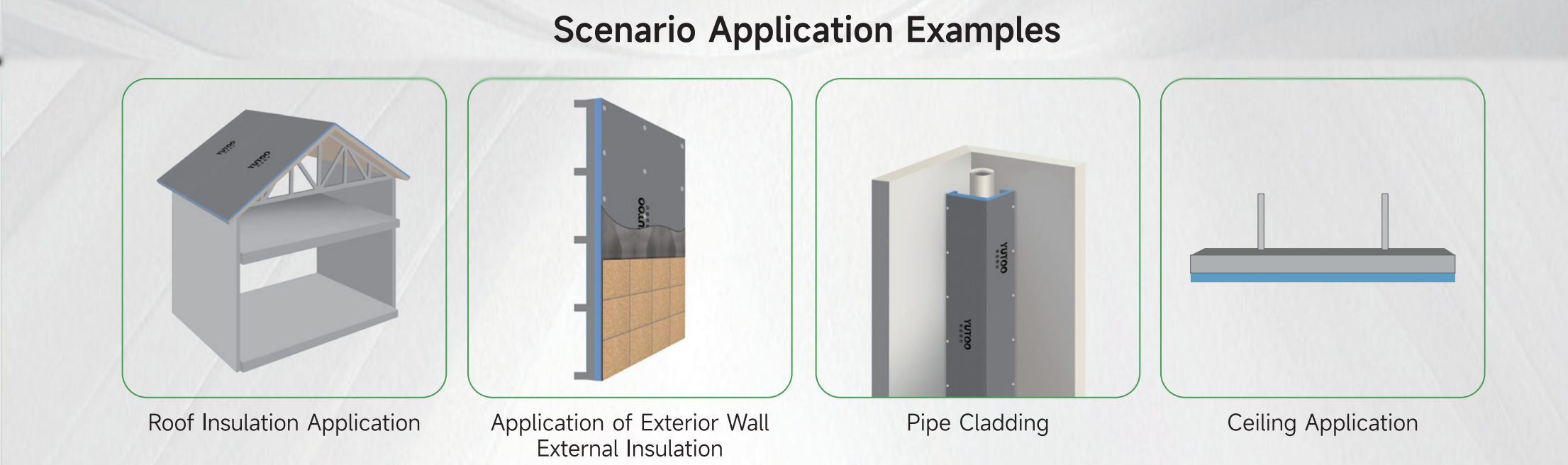
1. Roof Insulation Application
While tile backer boards are not typically specified as primary roof insulation, they are increasingly used in roof terrace tiling systems, balcony decks, and green roof pedestal zones where a waterproof, compression-resistant substrate is required beneath the finished walking surface.
Key application considerations:
Load-bearing capacity – Roof surfaces subject to pedestrian or maintenance traffic require a backer board with high compressive strength (typically ≥ 1.0 MPa) to distribute point loads and prevent localized failure under foot traffic or equipment.
Decoupling layer function – The board acts as a decoupling interface between the structural roof deck and the tile finish. This accommodates minor thermal expansion and structural deflection, reducing the risk of tile delamination or cracking – a common failure in directly bonded roof tiles.
Drainage integration – When installed over a waterproofing membrane, the backer board must be bedded in a mortar or drainage mat system that allows water to flow freely toward roof drains. Unlike standard wall applications, roof installations require positive slope-to-drain geometry to eliminate ponding.
Freeze-thaw resistance – For exposed roof areas in cold climates, closed-cell backer boards with low water absorption (typically < 0.3%) are essential. This prevents water ingress into the board matrix, which could lead to freeze-thaw damage and subsequent loss of tile bond.
Thermal insulation accommodation – In roof terrace systems, the backer board can be installed over a separate rigid insulation layer, serving as both a protective wear surface and a stable tile substrate. This layered approach ensures that the thermal insulation is shielded from mechanical damage while the tile finish benefits from a properly consolidated base.
Critical detailing includes: maintaining a minimum 2% slope, providing expansion joints aligned with the structural substrate, and flashing all parapet wall intersections and drain penetrations with compatible waterproofing tape.
2. Application of Exterior Wall External Insulation
In external wall insulation systems (often referred to as EIFS – Exterior Insulation and Finish Systems), tile backer boards are not used as the primary insulation. However, they serve a critical role in transition zones and hybrid systems where both insulation and tile finishing are required on the same exterior elevation.
Typical applications include:
Base of exterior walls – Areas susceptible to splash-back from ground moisture or snow accumulation benefit from moisture-resistant backer board installed over or in place of traditional insulation boards at the lower portion of the wall. This provides enhanced impact resistance and prevents moisture wicking into the insulation layer.
Tile-clad exterior facades – For architectural designs incorporating exterior ceramic or porcelain tiles, backer boards provide the required bond surface for tile adhesives. Unlike gypsum or standard insulation boards, tile backer boards offer a cementitious or composite face that is compatible with exterior-grade tile mortars (classified as C2 or higher per EN 12004 or equivalent standards).
Weather barrier continuity – When integrated with the building's air and water-resistive barrier (WRB), the backer board must be installed with lapped joints and sealed penetrations to maintain continuous protection against wind-driven rain.
Thermal and acoustic transitions – At wall-to-wall or wall-to-floor intersections, backer boards can provide structural reinforcement where discontinuities in insulation occur, reducing thermal bridging and maintaining acoustic isolation.
Installation requirements for exterior applications include: stainless steel or hot-dip galvanized mechanical fasteners (to prevent corrosion), taped and embedded joints with alkali-resistant mesh, and a reinforced base coat prior to tile application. Expansion joints should be placed at intervals not exceeding 6m vertically and horizontally to accommodate thermal movement.
3. External Insulation
Note: As noted above, tile backer boards are not insulation products. However, they are frequently used in external insulation systems as a protective cladding substrate. The following focuses on that protective and structural role.
Protective layer for external insulation systems:
Impact resistance – External insulation systems are vulnerable to mechanical impact from maintenance equipment, landscaping activities, and incidental contact. A layer of tile backer board installed over the insulation provides a durable armor face that disperses impact energy and prevents puncture of the underlying insulation and WRB.
Tile finish support – When the exterior building envelope is designed with a ceramic or stone tile rain-screen, the backer board serves as the direct substrate for adhesive and tile. Its low moisture absorption ensures reliable bond strength over the building's service life.
Moisture drainage plane – When installed with an air gap behind it (as part of a rain-screen assembly), the backer board functions as a drainage plane, allowing incidental moisture to drain downward and exit through weep details at the base of the wall.
System integration points:
Attachment methods – External applications typically require both adhesive bonding and mechanical anchoring to account for wind uplift and seismic forces. The fastener pattern should be specified by a structural engineer based on the building height, wind zone, and seismic design category.
Joint design – All joints between boards must be reinforced with mesh and finished with a polymer-modified base coat to provide both structural continuity and crack resistance. This treatment also bridges minor substrate movements without transferring stress to the tile finish.
Permeability management – The board's vapor permeability (typically ≤ 1 perm for closed-cell types) must be evaluated in conjunction with the overall wall assembly to ensure proper drying potential. Overly vapor-tight assemblies can trap moisture within the wall cavity, leading to long-term durability issues.
Where the external insulation is a separate product, the backer board should be installed with a compatible interface layer (such as a bonding primer or mechanical key) to ensure positive adhesion without compromising the insulation's thermal performance.
4. Ceiling Application
Ceiling installations represent a unique application for tile backer boards, particularly in wet ceiling environments such as showers, steam rooms, commercial kitchens, and swimming pool enclosures, as well as in exterior soffits subject to moisture exposure.
Primary applications include:
Shower ceiling tiling – In residential and commercial showers, the ceiling is often tiled to create a fully waterproof enclosure. Backer boards provide a lightweight, sag-resistant substrate that supports tile adhesion while resisting the persistent moisture and condensation conditions in the shower environment.
Steam room and spa ceilings – High-temperature, high-humidity environments demand backer boards with low thermal expansion coefficients and excellent dimensional stability. The board face must be compatible with steam-resistant tile mortars and grouts specifically formulated for temperature-cycling conditions.
Commercial kitchen ceilings – Ceilings in food service areas are subject to grease, steam, and frequent wash-down cleaning. A tile-finished ceiling over backer board provides a hygienic, cleanable surface that resists mold and bacterial growth.
Swimming pool ceilings – The combination of high humidity, chemical exposure (chlorine, bromine), and condensation requires backer boards with exceptional chemical resistance and vapor stability. Pool ceiling applications typically specify boards with enhanced fiber reinforcement to resist warping under sustained humidity.
Installation challenges and solutions:
Sag prevention – Unlike wall or floor installations, ceiling-mounted boards are subject to gravity, which can cause long-term creep or sag. Use of boards specifically rated for overhead applications, combined with appropriate adhesive coverage (≥ 90% contact) and mechanical fasteners at close spacing (typically ≤ 300mm centers), is essential to ensure permanent attachment.
Fastener selection – Corrosion-resistant fasteners (stainless steel or hot-dip galvanized) are mandatory, as ceiling surfaces in wet environments are particularly prone to condensation drip, which can corrode standard fasteners and lead to bond failure.
Overhead handling – Ceiling installations present ergonomic and safety challenges. Boards should be sized to be manageable by the installer (typically 1.2m × 0.6m or smaller) and lifted with appropriate mechanical assistance where necessary.
Penetration detailing – Ceiling penetrations for lighting fixtures, ventilation grilles, and sprinkler heads must be carefully sealed with waterproof gaskets or sealants to prevent moisture migration into the ceiling cavity. These penetrations also require structural reinforcement to prevent cracking around openings.
Fire-rated assembly compliance – For ceilings separating different fire compartments, the backer board may need to contribute to the overall fire-resistance rating (e.g., 1-hour or 2-hour assemblies). The specific board thickness and joint treatment must be verified against tested system listings per local building regulations.
Acoustic considerations – In multi-story buildings, tiled ceilings over backer board can improve sound insulation between floors. Adding a resilient layer between the backer board and the structural substrate can further enhance airborne and impact sound insulation performance.